Think about these TTRPG villain tropes:
- The tyrant on the throne.
- The lich in the tower.
- The crime lord who never gets their hands dirty.
- The thing in the fog that no one names out loud.
We all associate these with intriguing villains who are larger-than-life. But in reality, most big bads end up feeling like a high-CR speed bump at the end of a dungeon. They have a monologue, the PCs try to stop them, combat ensues, and then loot is distributed. The fantasy you had about the menacing villain suddenly falls flat.
If you want a major villain to stick in the minds of the players, you have to design them differently.
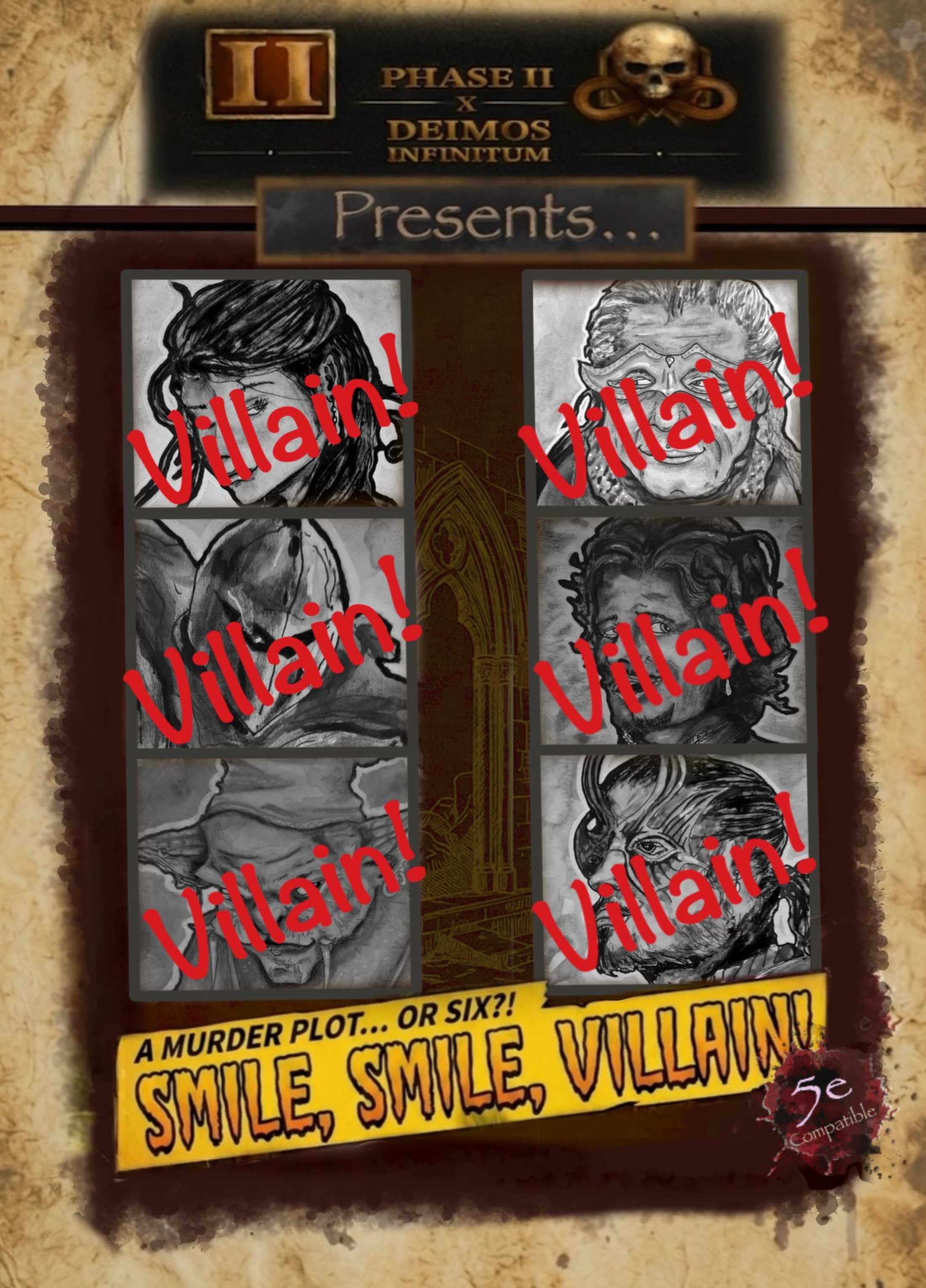
Check out Smile, Smile, Villain!, a 5e adventure with intrigue, action, and lots of villainy:
Introduce the Shadow Before the Body
A truly menacing antagonist should be felt long before they’re seen. Let the players experience the villain’s presence before ever encountering them directly:
- PCs come upon a burned village and the only evidence of what happened is the villain’s symbol.
- PCs encounter characters who refuse to say the villain’s name.
- Rumors abound in inns and taverns, and the villain is already larger-than-life in the telling.
When players arrive in the aftermath of someone else’s encounter with the villain, they begin to shape who that villain is in their own minds. And it is almost always more impactful than anything you can describe directly. Consider the difference:
“You see a cloaked figure with long fingers approach you menacingly.”
“The torchlight flickers along the walls, shadows snapping and recoiling like serpents. But one shadow emerges from the rest. A hand, too long and too jointed, drags itself in your direction across the stone, its fingers bending in ways that aren’t possible. It swells into larger and larger shapes as it approaches, distorting, splitting, and then reforming. The air begins to turn cold. The torches scream out and die as something breathes in. But all that you can see now is darkness.”
Power That Operates Off-Screen
The most menacing villains act when the PCs aren’t there. They advance plans, punish defiance, replace lieutenants, seal off escape routes, and much more.
If the party fails a mission, the villain benefits. If they succeed, the villain adapts. Keep things in motion. Villains who constantly advance their plans and react to the actions of the PCs feel more alive. And when players realize the world is changing around them whether they are active in it or not, the tension begins to rise.
Control the Scale of Interaction
You don’t need to give your antagonist equal screen time to your player characters. Sometimes less is more. When the villain appears, they should control the space, and they should leave before the PCs can resolve things clearly.
Think in terms of asymmetry. Villains know more, have more pieces on the table, and have leverage. Don’t deflate their presence by allowing the PCs to fully interact with them before you’re ready. Let the villain dictate when the encounter ends.
Give Them Moral Gravity, Not Just Hit Points
An antagonist threatens a PC’s moral clarity, not just their body. Maybe they offer a PC exactly what they secretly want. Maybe they expose something about a character’s past that they didn’t want revealed. Maybe they reveal that the party’s victories were always part of the plan. Or maybe they introduce a moral dilemma that divides the PCs.
Moral pressure lingers. If your villain only attacks hit points, they’re replaceable. When they attack a character’s beliefs or values, that’s when they become unforgettable.
Consider When Not to Give a Stat Block
Not every major villain needs to be killable. Some antagonists work better as a curse, a bloodline, a god, or a phenomenon. If the players can reduce your major villain to a stat block, you are signaling to them that the conflict can be solved with violence. Sometimes that’s appropriate. But sometimes things are more interesting if violence is not an option.
Other ways to deal with a major antagonist:
- Survive it.
- Outmaneuver it.
- Contain it.
- Escape it.
- End its influence without ever facing it directly.
Larger-than-life adversaries feel more mythic when they can’t just be stabbed. Especially in horror games, reducing an antagonist to a stat block can deflate the entire tone of the campaign. It’s why in Horror at Yishusu Landing, I didn’t make a stat block for the true threat of the campaign. PCs must find a way to deal with it by thinking beyond combat. Sometimes it’s best to let some forces remain forces.
Make Them Win at Least Once
If the villain never has a victory of their own, they stop being credible. Let them kill someone important, ruin a city district, corrupt an ally, escape with what they came for, or frame the party.
When players have felt the cost of failure, the villain becomes real. The PCs begin to respect them as a worthy opponent, and every subsequent encounter carries stakes that didn’t exist before.
Let Fear Travel Through NPCs
You don’t have to describe the villain’s power directly. You can show it through the world’s reaction to them:
- Hardened warriors refusing contracts.
- Priests lowering their voices at the name.
- Criminals paying tribute without complaint.
- A rival adventuring party that tried and failed.
When the world reacts to the villain with caution and fear, the players will too.
Resist the Urge to Over-Explain
Menace lives in the unknown. If you reveal everything, you risk dissolving all the tension. Keep things simple. Reveal information little by little. When you explain too much, you take away the mystery and limit the impact of the villain’s true plan.
Let players fill in the gaps. The villain they imagine is often more frightening than anything you can describe outright.
The Real Goal
A major villain shouldn’t just feel like a final boss in a video game. They should affect the world around them, almost like a gravitational force. You’ll know you’ve succeeded when:
Then you’ve succeeded at making the antagonist larger-than-life.
And if, at the end of your campaign, the villain’s defeat feels less like “we killed it” and more like “we survived it” or “we changed the world enough that it no longer holds power,” then you’ve created something far more lasting than a stat block.
Your players will remember that long after any damage total is forgotten.