There is a creature at the end of the dungeon. It attacks twice per round: once with its claws, once with its tentacles. Roll for initiative.
If that sentence just made you feel nothing, then you know the problem. Cosmic horror is one of the most misunderstood modes of storytelling, especially in tabletop roleplaying.
Cosmic horror, the genre mostly attributed to H.P. Lovecraft and explored in films like Annihilation and The Void, is frequently reduced to alien tentacles, massive beings, and ruined temples. But those are just set dressing. The actual engine of cosmic horror is something much more unsettling.
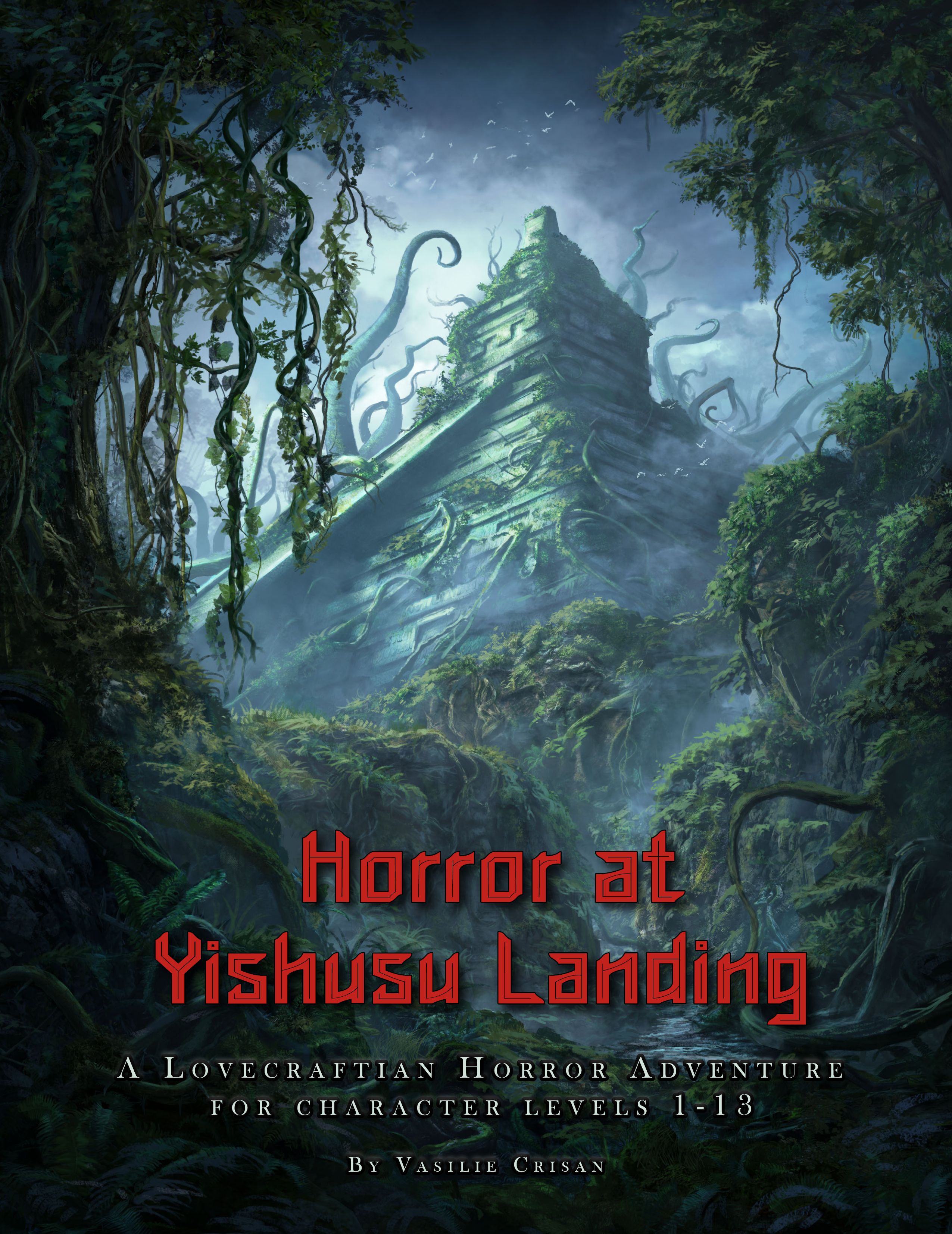
For an entire campaign centered around Lovecraftian cosmic horror themes, check out Horror at Yishusu Landing:
This article is about that engine, and about how to make players feel genuinely small. Uncertain. Afraid. It is about a world that has quietly revealed that it doesn’t care about them at all, a world where the monsters are just a confirmation that the true horror is undeniable.
What Cosmic Horror Actually Is
The term “cosmic horror” gets used loosely, but it has a pretty specific meaning. At its core, cosmic horror is about coming up against indifference at a massive scale. An evil being wants something from you, even if it is your death, which means you matter. A cosmic entity doesn’t. The universe it inhabits simply doesn’t have a category for human significance.
This is what separates Lovecraft’s work from a typical monster story. The Deep Ones are terrifying because their existence implies that human civilization is a footnote in a grand scheme we can’t fathom or perceive, not because they can drag you beneath the waves.
The immense existential weight of that idea is maddening. Terrifying. Everything else is really just atmosphere. When you translate this to tabletop, the mistake most GMs make is focusing on the atmosphere and forgetting that underlying idea. They add weird visuals, unsettling NPC behavior, and monsters with a lot of tentacles. Then they wonder why their players feel tense but not truly disturbed. The tension dissolves the instant someone rolls high enough on an attack.
The Stat Block Problem
Fundamentally, tabletop RPGs are about player agency. Characters have unique abilities, the world responds, and everybody has fun. But this is at odds with the fundamental elements of cosmic horror.
Cosmic horror is about losing agency. It’s about discovering that your skills, knowledge, and abilities are insufficient when facing the real threat. The horror isn’t that you will die. It is knowing you can die and not even be noticed.
A stat block makes it very difficult to broadcast this feeling to players. If it has hit points, it can be killed. The moment your players are rolling dice to damage it, they’re engaged with it on their terms. This gives them power, which kills cosmic dread.
In most games, the Ancient One shouldn’t have a stat block. It should have a presence, something that warps the space around it. “Defeat” must mean something different than dropping hit points to zero. Maybe PCs can seal it away, make it go dormant for centuries, stop a ritual, or wake up to realize it was never actually there. These resolutions maintain the horror because they tell the players they never truly defeated the entity. They merely survived it.
Building Dread
If combat can’t be your primary mechanism to deliver tension, what do you do? The best cosmic horror stories have a sense of wrongness, a feeling that something isn’t right and probably hasn’t been for longer than anyone can imagine. The Delta Green adventure Night Floors does this with a masterful stroke.
Dread at the cosmic level accumulates into a crescendo and is rarely sudden. By the time the players realize something is wrong, they should have had the floors shift on them several times. Here is how to build that feeling.
In the early sessions of a cosmic horror adventure, the existence of a supernatural force should be deniable. Things appear wrong, but at a level that can be rationalized. Maybe there are inconsistencies in what an NPC remembers. Maybe PCs go through a door that seemed like it should lead somewhere else. Or, like in Horror at Yishusu Landing, two characters having dreams that are eerily identical.
Players may attribute such things to coincidences, manipulation, or something else. As things grow more disturbing, they can no longer be explained away. Some practical examples: have NPCs be too certain about things they shouldn’t know, describe geometric shapes or architecture that don’t add up, or have PCs find documents that contradict other information they’ve gathered. The events should nag at the back of the mind instead of being immediately threatening.
The next layer is about removing things players rely on to feel grounded. This is where you as a GM need to deliberately break the usual unspoken contract with your players. Although taboo in most TTRPGs, this is vital to delivering the experience of cosmic horror.
Begin introducing events that your players can’t verify:
- A missing NPC who some characters remember and others don’t.
- A location that doesn’t appear on any map, but that characters have been to.
- Flashbacks or memories of events that players aren’t sure really belong to their characters.
Be careful here. The goal is not to frustrate players by making everything unreliable. Confusion is like a puzzle and becomes frustrating when there is no solution. Dread is the feeling that you don’t really want to solve what is happening. That is the difference, and that is the feeling you are going for.
The best question you can leave hanging in a cosmic horror game is not “what is this thing” but “how long has this been true.”
In adventure games, knowledge is almost always an advantage. You investigate, you learn things, and you’re better equipped to deal with what’s coming. Cosmic horror is exactly the opposite. Design your mysteries so that uncovering them is more unsettling as players dig deeper:
- The players find the cult’s records and learn what the ritual actually does. And it is truly horrifying.
- They translate an inscription and realize it’s about the town’s founding. But the founding was a deal, not a standard settlement.
- They learn who the mastermind is, and it is a person who has been dead for 40 years.
Every time PCs uncover more, the ground shifts. They realize the truth is horrible and that it has been around for much longer than they imagined.
This is one that often gets neglected. It’s tricky for some because they take indifference to mean that PCs shouldn’t have a personal stake. But tying the PCs and their backstories to the events of the adventure adds urgency and makes the horror land harder:
- PCs discover that an entity has been watching the town for centuries, and one of the PCs has family there.
- The forbidden archive has information that is deeply personal to one of the PCs.
- Insignificance lands hardest when players have spent six sessions helping people, making connections, and preventing catastrophe, only to learn that a force might decimate it all without even noticing.
Let them care first. Then let the horror challenge that caring. They saved the village, yes. But the village was already part of something older. Did saving it change anything?
Running the Encounter (Without Fighting It)
At some point, the PCs are going to come face to face with the horror. Whatever it might be, they will be in a scene with it. At this moment you have the ability to make it truly memorable or let it devolve into a standard boss fight.
The core challenge: keep the players active while giving them the feeling of powerlessness. Players need to be doing things to stay interested, but the horror simply continues to exist. Keep the entity indifferent, unaware of the PCs, doing whatever it was always going to do.
Give them a solvable problem adjacent to an unsolvable one. The creature can’t be killed, but PCs can stop the ritual or destroy the anchor keeping it in this world. The main villain may have started a transformation that can’t be undone, but PCs may be able to remind them of who they once were.
When the PCs succeed, let them enjoy their victory. Don’t make them feel like it was all for nothing. The horror was displaced, laid dormant, or delayed for a century. As empty as that victory feels, they solved what they could. The rest was always beyond them.
Use the Environment as the Horror’s Voice
Instead of having the horror speak or communicate directly, let the world around the PCs respond to its presence. Gravity is altered, sound is distorted in strange ways. NPCs who have been exposed to it begin to develop strange qualities. The PCs’ own perceptions become unreliable.
These effects should be sensory and specific, not mechanical. It shouldn’t be “you take 1d6 psychic damage” but more like “you realize you’ve been standing here for what felt like just a few minutes, but your candle has completely burnt out.”
Let Them Know They Were Seen. Once.
The most powerful moment in a cosmic horror story is attention. If the entity is truly indifferent, the moment it notices a character, however brief, is a genuinely terrifying one. Think of the climax of Lovecraft’s “The Call of Cthulhu.”
This should happen once, very deliberately. Whatever the PCs were, whatever they’ve done, for one impossible moment they got the attention of something that has no particular reason to look at them. And then it looks away.
That kind of moment does more for horror than a thousand claw attacks.
Sanity, Trauma, and Mechanical Dread
Most systems that engage with cosmic horror include some kind of sanity or stress mechanic, a resource that degrades as characters face horror and the impossible. These systems can be great tools, but sometimes adventures rely on them too much.
Many GMs treat sanity loss as another type of damage. Sanity mechanics work best when they have impact on a character beyond a debuff. When a character loses sanity, they sometimes perceive the world differently. Maybe they begin to notice things they couldn’t before. Maybe they lose trust in an NPC they once relied on. Maybe the horror starts to make a terrible kind of sense to them.
Some of the best implementations of this are in the way Delta Green handles bonds. It’s not just “you lose a sanity point” but “something about this relationship with this person has changed, and you’re not sure how to fix it.” Or the way Vaesen uses conditions that slowly change the way a character sees the world.
If you’re running a system without sanity mechanics, you can do this through roleplay. Ask players who’ve experienced significant horror to describe how their character is making sense of it. Ask what the most reasonable explanation they can construct is, rather than what their character believes. A lot of the time, the explanations they construct are more terrifying than anything you’d come up with yourself.
Main Themes
The stars were always there. We just forgot to look up.
There are several common themes in cosmic horror. By weaving them into your sessions, you can add genuine cosmic dread to your games.
When characters find themselves alone, amplify their vulnerability by focusing on what makes each one of them feel exposed or powerless. This personalizes the terror and intensifies the immersion.
Doubt makes players second-guess what’s real, their skills, and even their perceptions. Resist reassuring them. Doubt keeps the tension high. Let them grapple with mistrust, whether it’s a friendly NPC or the difficulty of an encounter.
Facing seemingly insurmountable odds is central to cosmic horror, but take care not to push players to full acceptance. Instead, provide them a flicker of hope, keeping them engaged without fully alleviating the tension.
Cosmic horror’s creatures exist beyond humanity’s understanding, often immune to harm and beyond mortal comprehension. Preserve their mystery and power by making them elements of the story rather than foes to defeat.
The real danger in cosmic horror lies in humans who dare to control forces beyond their understanding. Those who delve too deeply into ancient secrets spiral into madness or destruction. The true horror is not the creature itself but human ambition.
The climax of cosmic horror often reveals humanity’s smallness in the universe, a realization that shatters the players’ beliefs about their significance. Let this discovery unfold naturally. The characters’ choice to share or keep this knowledge could offer hope or bring about doom.
The Consuming Dark
Done with care, cosmic horror is one of the most uniquely immersive experiences roleplaying can offer. It uses the power of collaborative storytelling in ways that books and movies can’t fully replicate. When it works, players will remember it for years. Not because of what they killed, but because of what they glimpsed.
If you haven’t already, check out Horror at Yishusu Landing, a cosmic horror campaign for 5th edition D&D in which all of these concepts come together to bring true cosmic horror to life in a fantasy setting.